

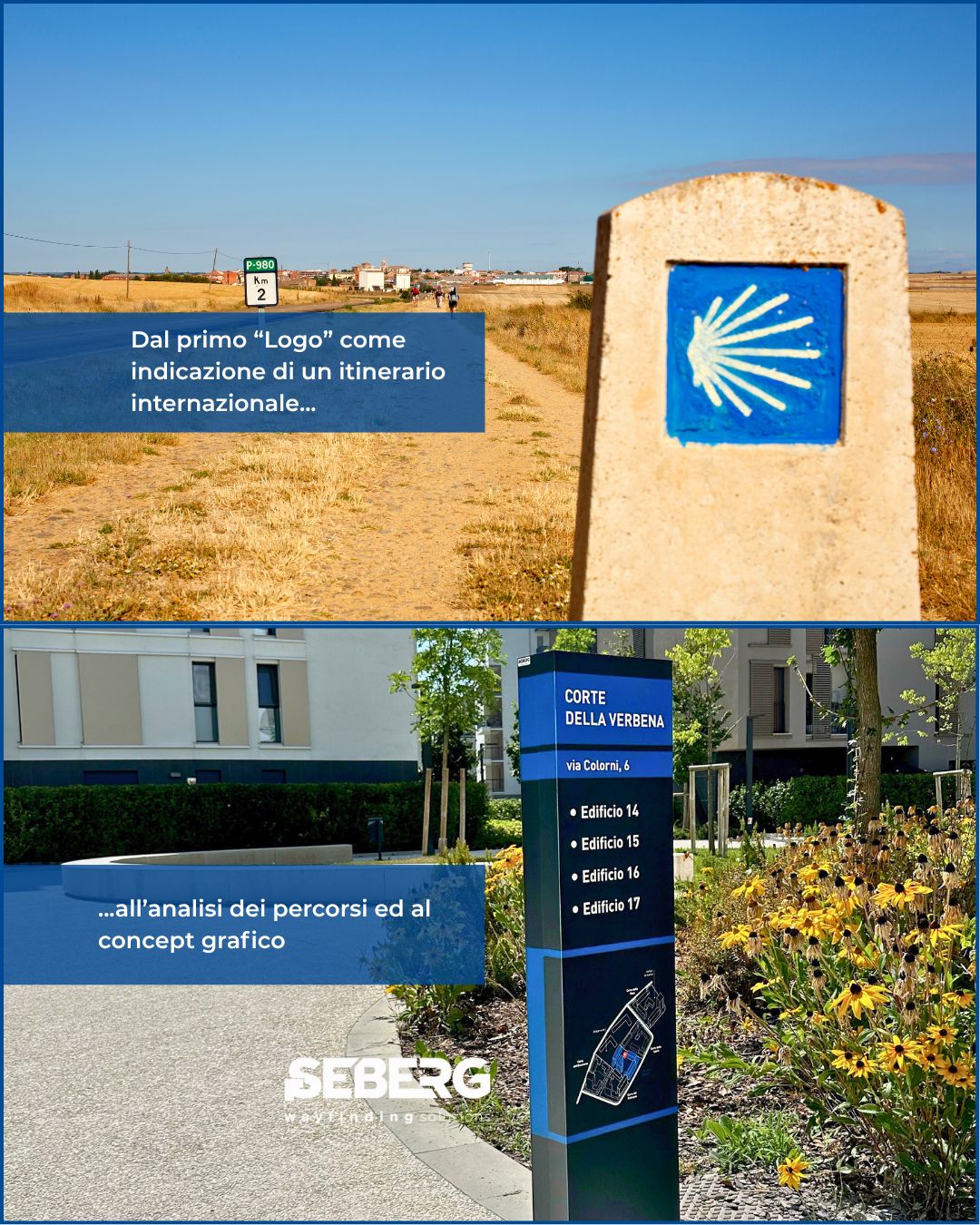
1. From carved stones to medieval symbolism
The Egyptians carved hieroglyphics to orient worshippers and merchants around their temples; the Romans placed milestones marking distances to guide travelers on the Appian Way.
In the Middle Ages, the scallop shell of Santiago became the first “logo” for an international itinerary: simply following it was enough to reach the Galician cathedral.
2. Industrial Revolution: the city lit up at night
As urban growth grew, cast iron and then illuminated signs organized flows in chaotic streets, while train stations standardized pictograms and colors for transnational passengers.
3. Modernity: branding + user experience
Italian case study: The modular system of the MIND Milano Innovation District uses fluid color hierarchies for two audiences (occasional visitors and everyday “Minders”).
In the terminals of 2025, interactive kiosks update gates, retail, and accessible routes in real time, reducing anxiety and operating costs.
4. Immediate future: data, inclusion, sustainability
Wayfinding becomes a platform: augmented reality, indoor maps on smartphones, recycled materials, and analytics that measure flows to optimize spaces.
How can we help you?
“Our mission is to transform signage into a design element that enriches spaces, making them more welcoming and easier to navigate.”
Integrated design: route analysis, graphic concept, certified in-house production.
Digital-ready solutions:
touch kiosks, QR-routing, API integration.
Sustainability:
recyclable materials and low-emission processes.
If you manage shopping centers, airports, hospitals, campuses, public administration offices, or architectural firms, let’s talk about how wayfinding can:
Reduce staff inquiries by 30%;
Increase retail revenue thanks to smoother flows;
Improve accessibility for all users.
Follow Seberg for more insights into design, signage, and smart spaces.
